
.png)
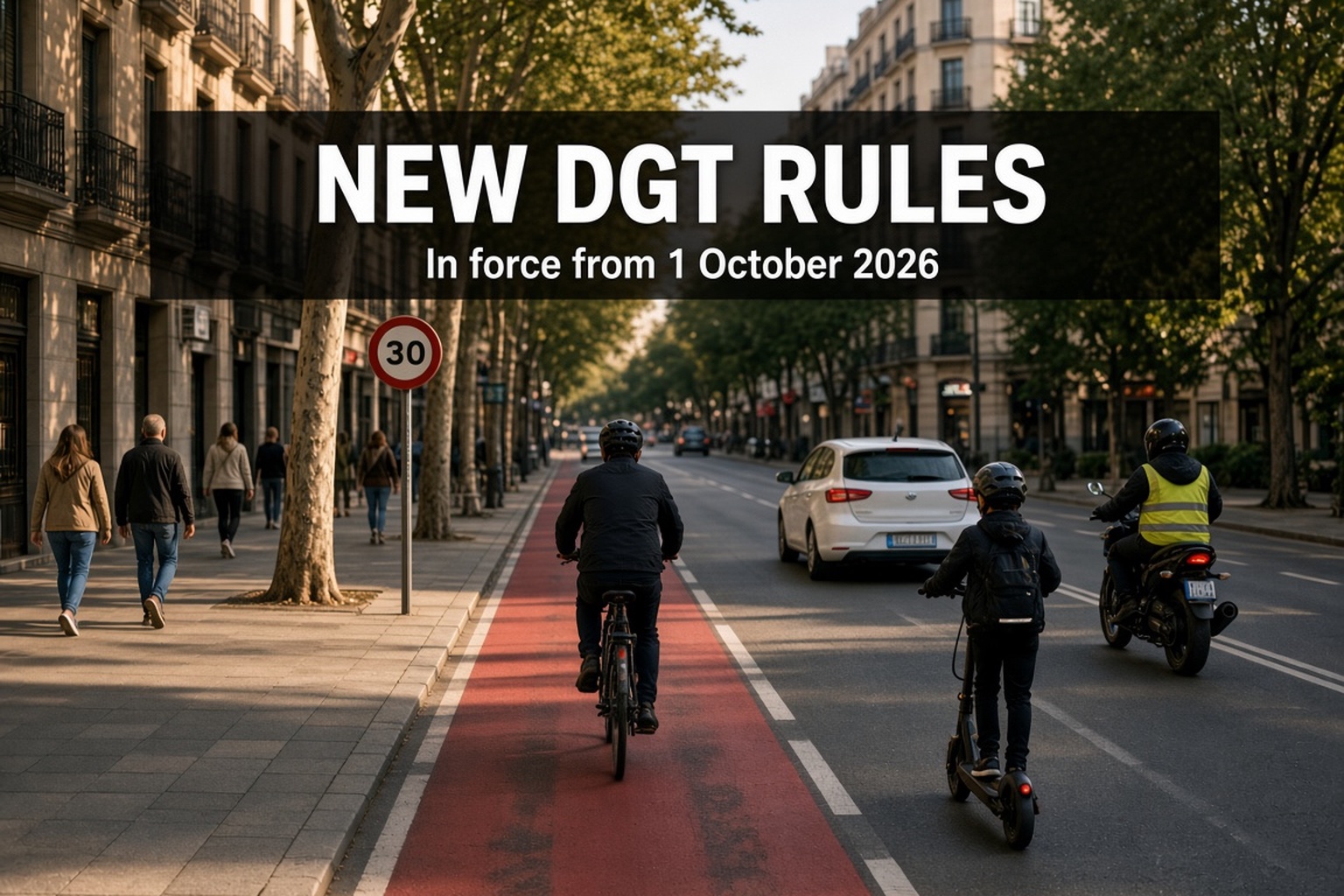
Already updated: ConducIA's digital book and question bank were updated on 1 October 2026 to the new rules, checked line by line against the official text published in the BOE.
What is Real Decreto 518/2026?
Real Decreto 518/2026, of 24 June, was published in the BOE on 26 June 2026 and came into force on 1 October 2026. It updates the Reglamento General de Circulación (the General Traffic Regulations), more than 20 years after it came into force, to reflect how mobility has changed: the focus has moved from roads and vehicles to people and urban areas.
The reform is built around two ideas:
- Protecting vulnerable road users. For the first time, the law defines them: pedestrians (especially children, older people and people with disabilities or reduced mobility), cyclists, riders of personal mobility vehicles (VMP, such as e-scooters), and riders and passengers of motorcycles and mopeds.
- Safer, more sustainable towns and cities. A new Title VI sets out specific traffic rules for urban areas: cyclists, e-scooters, pavements, parking, low-emission zones and safe school routes.
Does the theory exam change?
The format of the Permiso B theory exam does not change. The DGT has confirmed that "for now everything stays the same": 30 multiple-choice questions, 30 minutes and a maximum of 3 mistakes to pass.
What does change is the content. The exam questions are based on the regulations in force, so the new rules become part of the syllabus, and some answers that were correct until 30 September are now wrong. For example, cyclists no longer have an exemption from wearing a helmet on long climbs or in extreme heat.
When will the new questions appear? The DGT has not set a specific date. If you are taking your exam after 1 October 2026, learn the new rules now so you are ready for them.
Overtaking cyclists and other vulnerable users: 1.5 m on any road

The 1.5 m gap is not new in itself: it already applied when overtaking outside built-up areas. Inside built-up areas, the old rule only asked for a margin proportional to speed and road width. Now, when you overtake pedestrians, animals, animal-drawn vehicles, mopeds, VMPs, cyclists or groups of cyclists:
- Leave a lateral distance of at least 1.5 metres on any road, now also inside built-up areas. You may partly or fully occupy the adjacent lane to do so.
- New: outside built-up areas, drive at least 20 km/h below the road's speed limit, before starting and throughout the manoeuvre.
- New: a group of cyclists counts as a single unit.
- New: on roads with more than one lane in each direction, you must change lanes completely.
The same idea now applies to immobilised vehicles. When you pass a vehicle stopped by a breakdown, crash, roadside assistance, road maintenance or traffic control that occupies your lane, you must leave at least 1.5 m and slow down to at least 20 km/h below the limit, on any road.
Cyclists in towns: centre of the lane and a 5 m gap
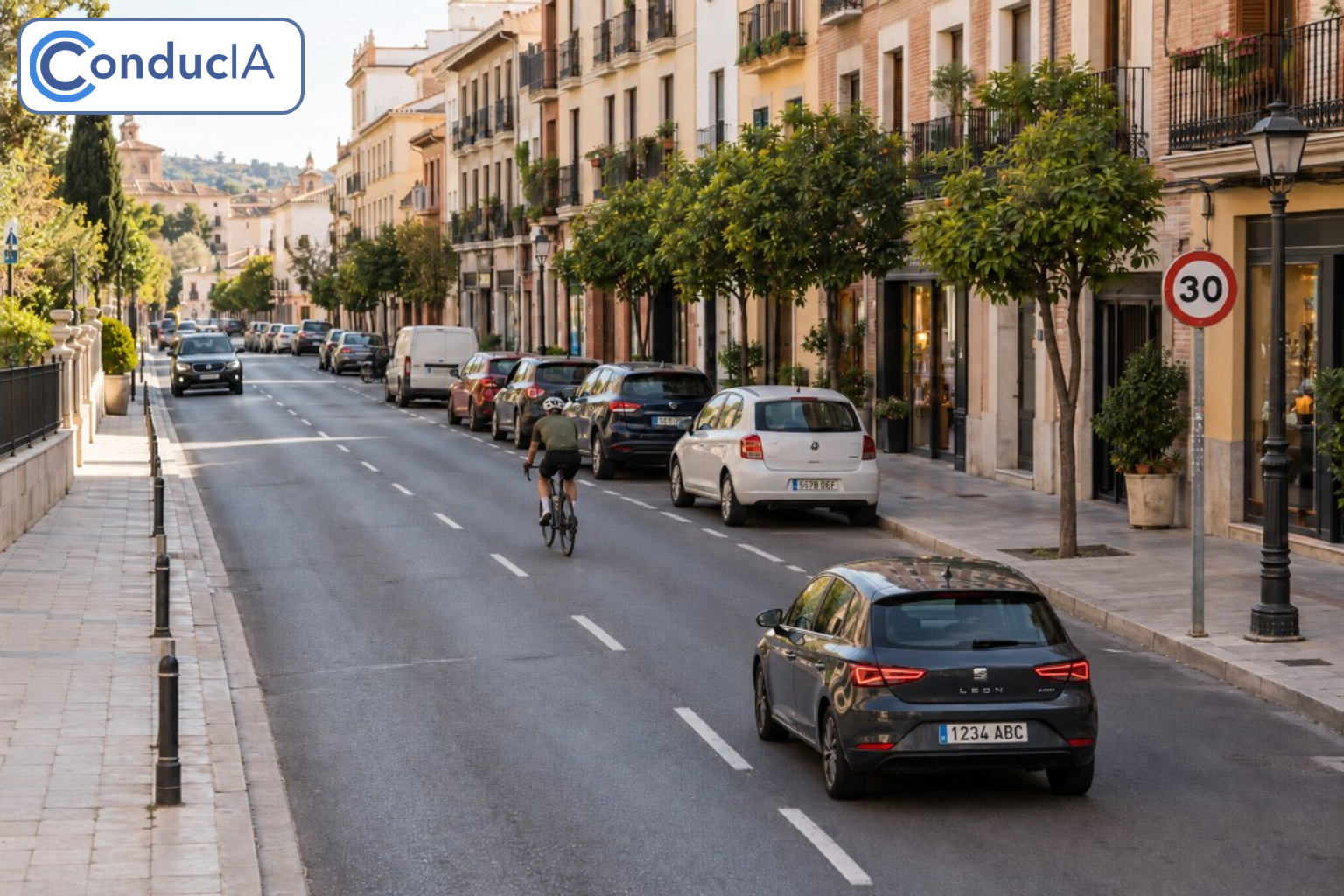
- Cyclists ride preferably in the centre of the lane. On streets with two or more lanes per direction, they use the right lane, except to turn or for safety.
- Motor vehicles must keep at least 5 metres behind a cyclist riding ahead of them in the same lane.
- Where there is a bike lane, cyclists should use it, and it is compulsory when the R-407a sign is present.
- Cyclists may overtake on the right or the left, and filter past stopped vehicles to reach the advanced stop box.
- On single-lane streets limited to 30 km/h or less, the council may allow cycling in both directions with signs.
Helmets: on interurban roads, the helmet is now compulsory for all cyclists, with no exceptions (the old exemptions for long climbs and extreme heat are gone). Under-16s must wear one on all roads. At night or in poor visibility on interurban roads, cyclists must also wear at least one luminous or reflective element visible from 150 m.
Bicycles can also carry loads and passengers if the rider is an adult: children up to 22 kg who can sit up on their own, in a homologated seat, and trailers for people, animals up to 15 kg or loads. On interurban roads, only in daylight and good visibility.
E-scooters (VMP): minimum age 15 and a helmet
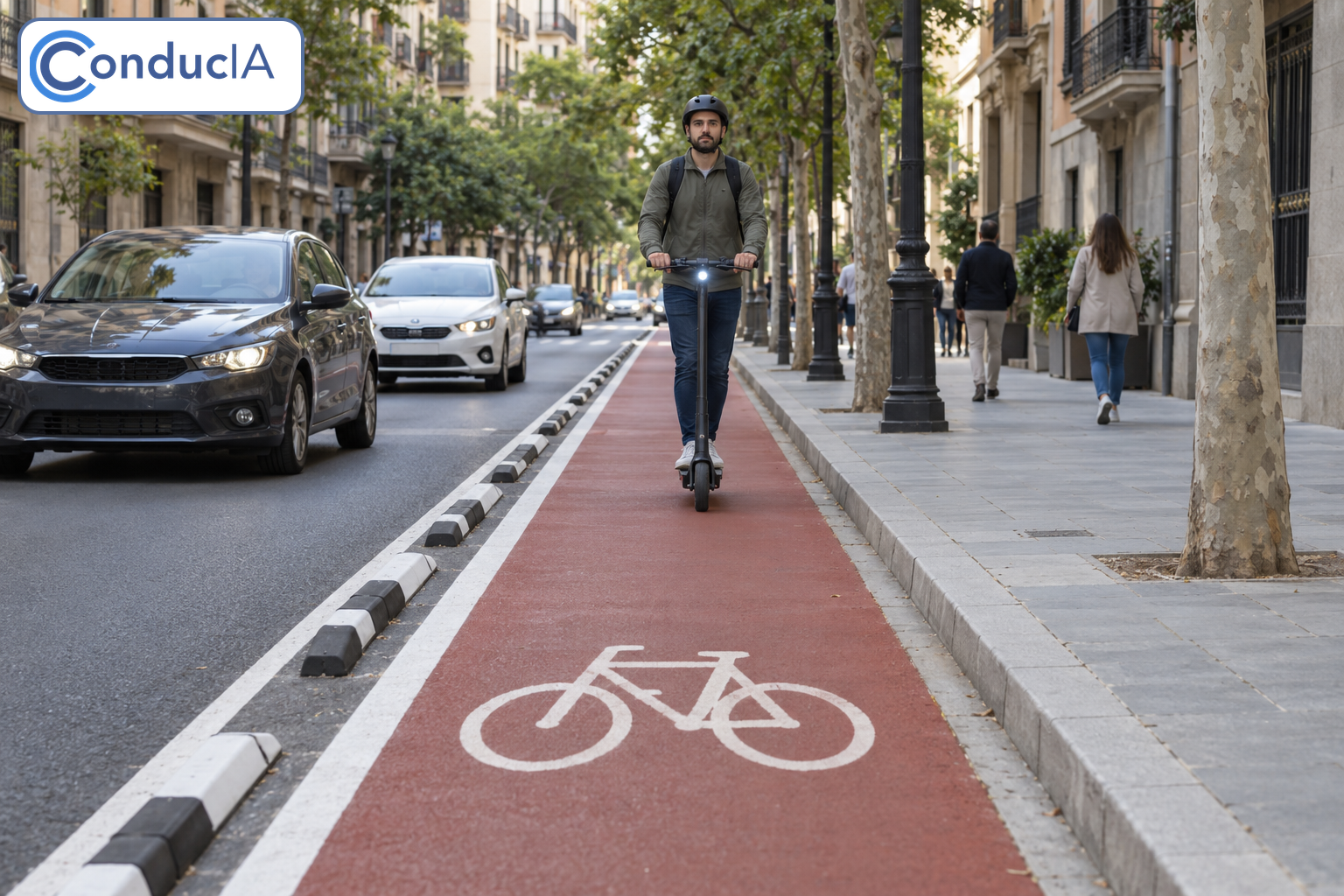
Personal mobility vehicles (VMP) are vehicles with one or more wheels and a single seat, powered only by an electric motor, with a design speed between 6 and 25 km/h. The new rules for their riders:
- Minimum age: 15 years. Only one person may ride.
- Helmet always, fastened.
- Signal manoeuvres by arm.
- At night or in poor visibility: lights on and at least one luminous or reflective element visible from 150 m. The DGT's summary describes this as a reflective vest, which is one way to comply.
- Never on pavements. In other pedestrian zones (squares, promenades…), only if a municipal ordinance allows it, always giving pedestrians priority.
- Outside built-up areas, only on routes separated from motor traffic, such as cycle routes and bike lanes, unless signs prohibit it. Always forbidden on autopistas, autovías and travesías (through-town stretches of a main road).
What about roller skates and skateboards? Each council now decides, by municipal ordinance, which roads and areas they may use and under what conditions.
Motorcycles and mopeds: gloves, closed footwear and the hard shoulder
- Helmet homologated under UNECE Regulation No. 22, for rider and passenger, on all roads. On mopeds, a certified helmet is still accepted until 30 September 2027.
- Protective gloves are compulsory on interurban roads for riders and passengers of motorcycles, mopeds, three-wheelers, quadricycles and quads.
- Closed footwear covering the whole foot, on all roads.
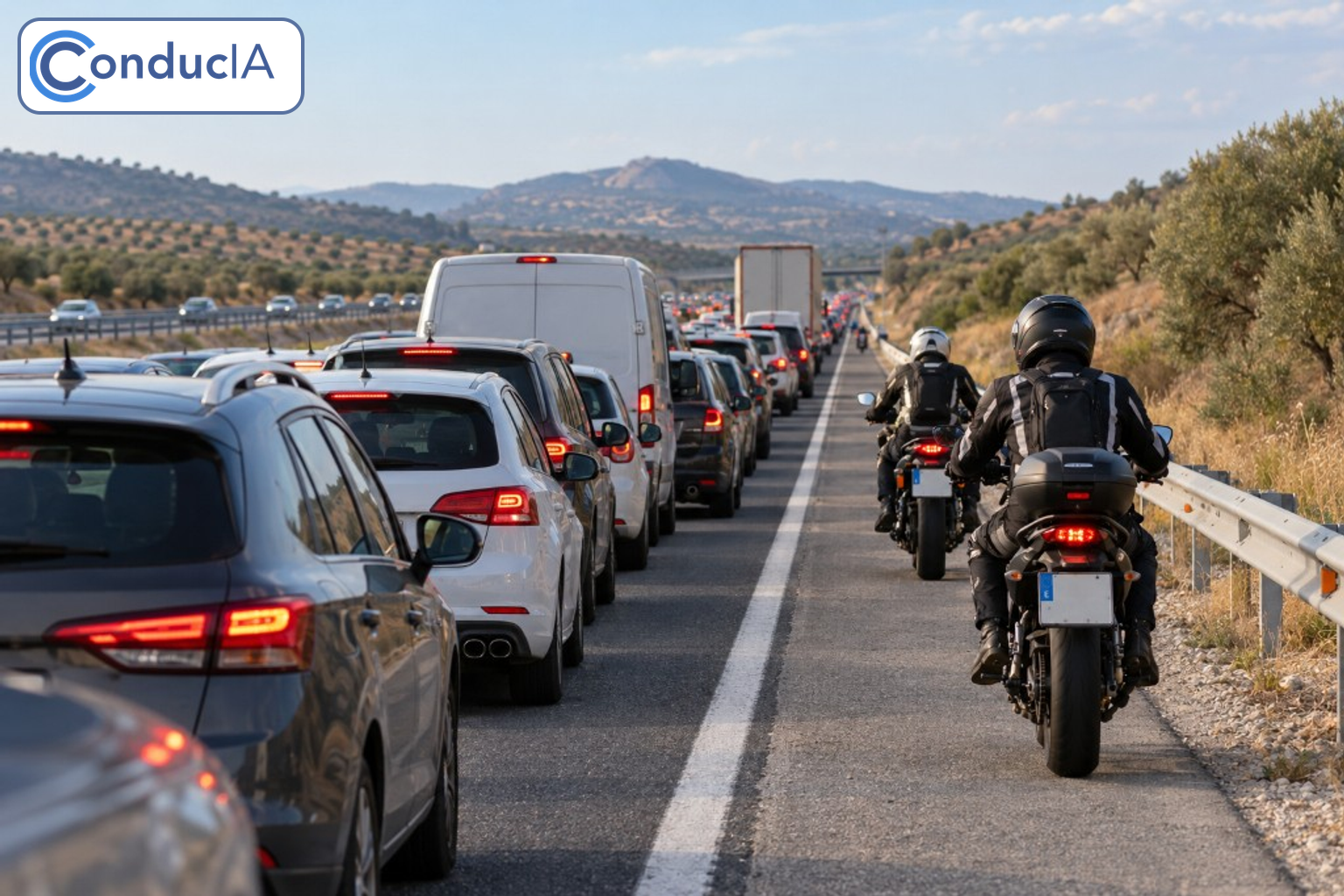
- On stretches signed for it, motorcycles may ride on the right hard shoulder when the traffic lanes are stopped by congestion: at no more than 30 km/h, in single file and with extreme caution.
- Motorcycles must carry a high-visibility vest, which the rider must wear when getting off and standing on the carriageway or hard shoulder of an interurban road.
Delivery riders and anyone riding for work (motorcycle, moped, bicycle or VMP) must wear a high-visibility vest on all roads, and cyclists who ride for work must wear a helmet in towns too.
Emergency corridor and driving in snow
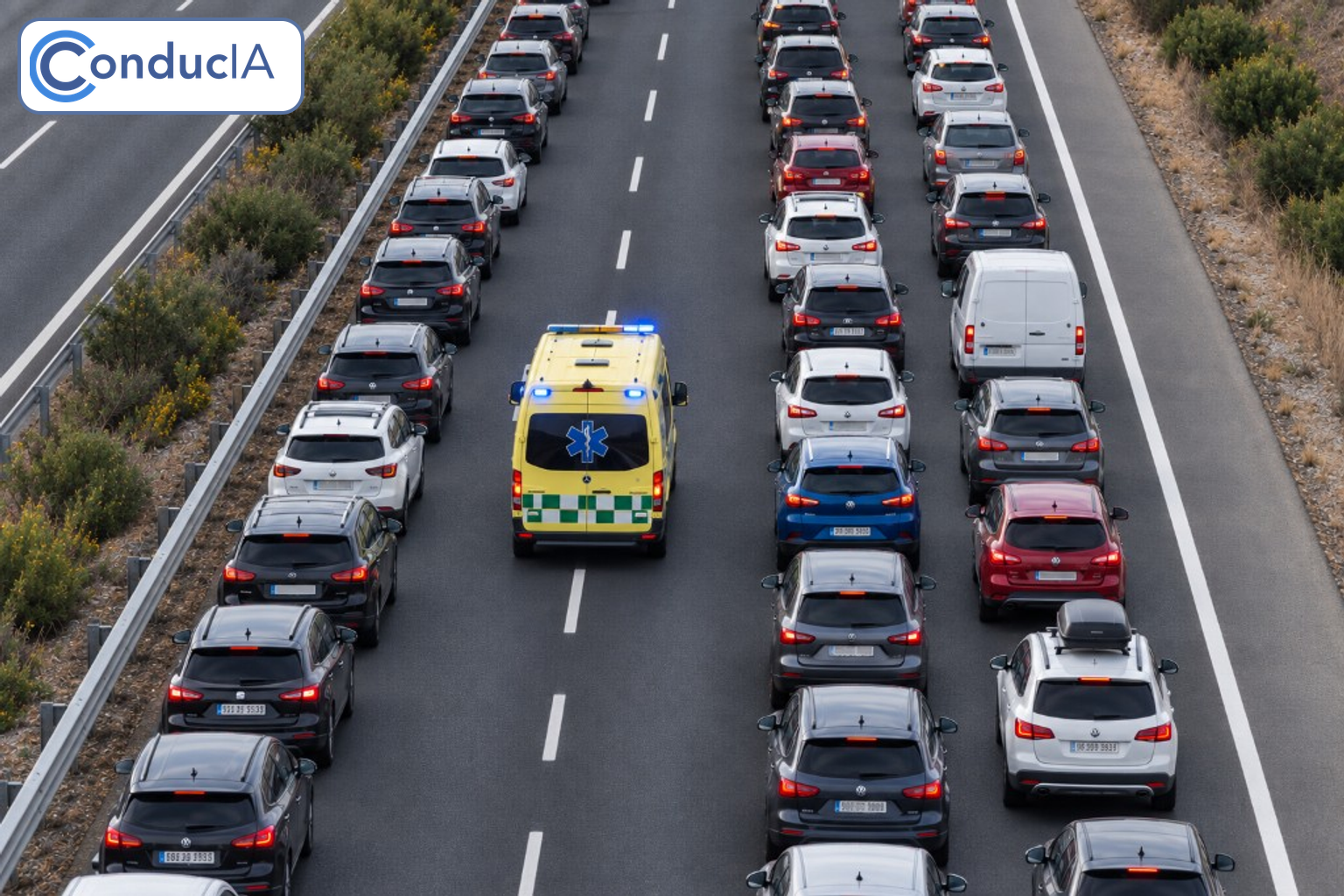
On autopistas and autovías, when a tailback slows traffic to walking pace or brings it to a stop, drivers must move aside to leave an emergency corridor for priority vehicles:
- Two lanes per direction: the corridor opens in the middle, between the two lanes.
- Three or more lanes: the corridor opens between the leftmost lane and the next one. Vehicles in the leftmost lane move left, and everyone else moves right.
When snow affects traffic on autopistas and autovías, overtaking is banned. You must drive in the right-hand lane (or the next one, where there are three or more lanes per direction), leaving the lanes to the left clear for emergency vehicles and snowploughs.
Pedestrians and urban areas
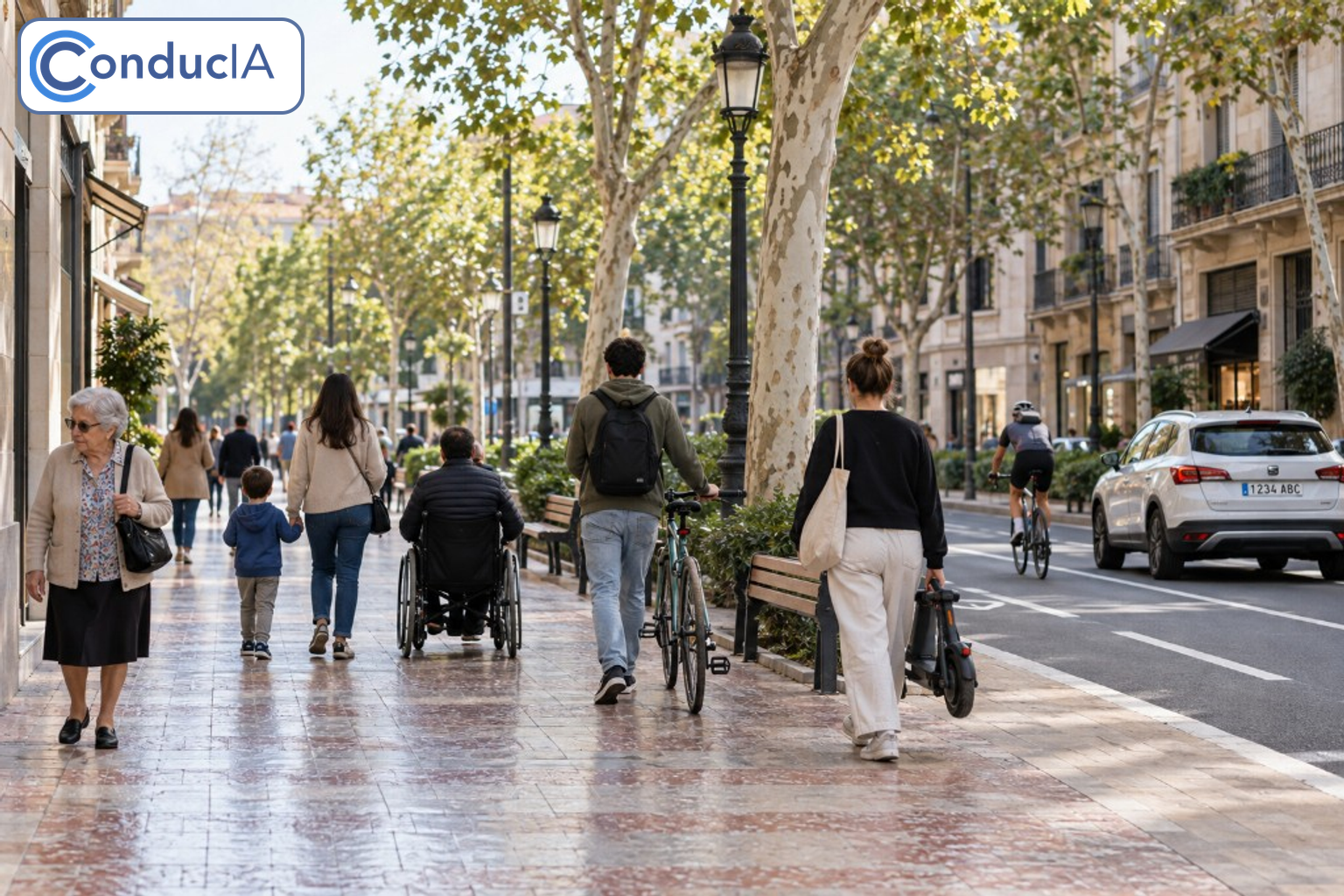
- Pavements are for pedestrians. No vehicle may be ridden on them. The only exception: a municipal ordinance may allow children up to 12 to cycle on the pavement, accompanied by an adult on foot.
- On shared-level streets (where the carriageway and pavement are at the same level), pedestrians have priority.
- Councils can create residential priority zones, restrict access to low-emission zones and set up safe school routes with lower speeds and restrictions on motor vehicles.
- People with reduced mobility travelling on a VMP at walking pace count as pedestrians.
- At pedestrian crossings with their own traffic lights, as a general rule, the flashing amber light for vehicles may not show at the same time as the steady green light for pedestrians.
Other changes: seat belts, buses and motorhomes
- Seat belts: the exemptions that applied in built-up areas to taxi drivers on duty, delivery drivers making repeated short stops, and the person at the dual controls during driving lessons and tests are gone. They must now always wear the belt. A new exception covers passengers attending the patient in ambulances equipped to provide medical care en route, on an emergency call.
- Buses carrying authorised standing passengers, or without seat belts, have a maximum of 80 km/h on any road outside built-up areas, now including autopistas and autovías.
- Motorhomes must park without extending anything beyond their outline (awnings, steps, tables…), resting only on their tyres, and without discharging any fluids from the living area.
Key dates to remember
- 1 October 2026: Real Decreto 518/2026 comes into force.
- 30 September 2027: last day mopeds may use a certified (non-homologated) helmet.
- 1 October 2027: VMPs must ride with their lights on at all times, during the day too.
- Pending: a ministerial order will set the technical specifications for protective gloves. Until then, current protective gloves are valid.
How to study the new rules
The fastest way to get ready is to study the new rules in context, together with the rest of the syllabus, and practise with questions that already reflect them. If you are just starting, also check the new traffic signs introduced in 2025, which are already in the exam.
ConducIA is the most modern way to prepare for the Permiso B theoretical exam, designed to help you learn faster, stay motivated, and pass on your first try. It includes a complete 15 chapter syllabus, +2000 questions, interactive games, AI learning, and more. Let's see how it compares to traditional platforms:
| Feature | Traditional platforms |

|
|---|---|---|
| +2000 theory questions | ✓ | ✓ |
| Updated to the 1 October 2026 rules | — | ✓ |
| Topic tests | — | ✓ |
| Error tests | — | ✓ |
| Adaptive learning (with AI) | ✗ | ✓ |
| Interactive games | ✗ | ✓ |
| Digital book included | Separate (€10+) | ✓ |
| Gamification (streaks and badges) | ✗ | ✓ |
| Prizes and competitions | ✗ | ✓ |
| English version | ✗ | ✓ |
| Affordable pricing | ✗ | View pricing |
Frequently asked questions
Does the Permiso B theory exam change on 1 October 2026?
The format does not change: 30 multiple-choice questions, 30 minutes and up to 3 mistakes. What changes is the content, because the exam is based on the regulations in force, and the new rules are now part of them.
How much space must I leave when overtaking a cyclist?
At least 1.5 metres, on any road. Outside built-up areas you must also drive at least 20 km/h below the speed limit, and on roads with more than one lane per direction you must change lanes completely.
What is the minimum age to ride an e-scooter in Spain?
15 years. VMP riders must also always wear a helmet and may never ride on the pavement.
Can motorcycles ride on the hard shoulder?
Only on stretches signed for it, when the traffic lanes are stopped by congestion, at no more than 30 km/h and in single file.
Is my certified moped helmet still valid?
Yes, until 30 September 2027. From 1 October 2027, moped riders and passengers need a helmet homologated under UNECE Regulation No. 22, the same as on motorcycles.
Official sources
- BOE - Real Decreto 518/2026, de 24 de junio: https://www.boe.es/eli/es/rd/2026/06/24/518
- DGT - Entra en vigor la reforma del Reglamento de Circulación (30 September 2026): https://www.dgt.es/comunicacion/notas-de-prensa/20260930-reforma-del-reglamento-de-circulacion-usuarios-vulnerables/